【华尔街日报】冬奥 “顶流” 冰墩墩,可谓 “一墩难求”
At the Olympics, the Lovable Panda Mascot Can Smile and Wave.
Bing Dwen Dwen is perhaps the first Olympic mascot in recent memory to win more plaudits than brickbats.
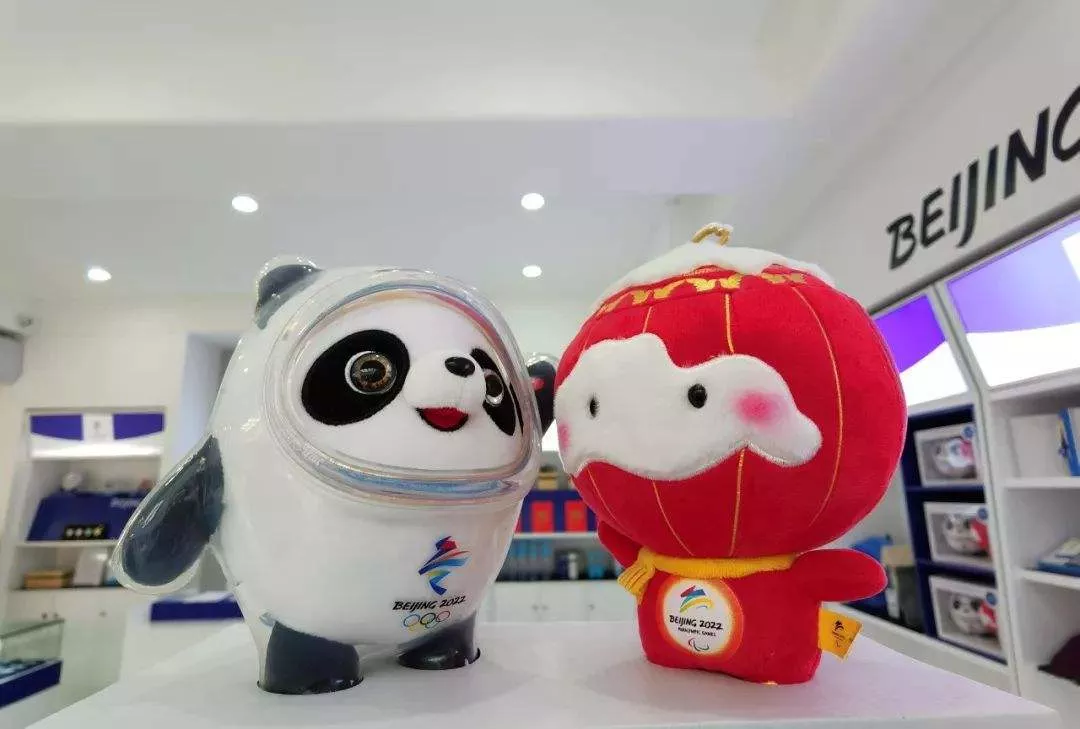
Beijing Winter Games organizers here have pulled off a rare feat in modern Olympics history. They’ve created a mascot that isn’t a total flop.
As it turns out, going viral is the easy part.
Now, organizers are racing to keep up with supply shortages, and fend off an uproar over the portly panda mascot’s voice and gender.
Bing Dwen Dwen, a glassy-eyed, ever-smiling panda clad in a transparent coating of ice that resembles a space suit, has emerged as the surprise breakout star of Beijing 2022, winning over an Olympic bubble full of athletes, coaches and journalists otherwise struggling to find joy in a morass of pandemic restrictions. China’s state-media hailed the mascot’s cuteness as “irresistible.”
That was, at least, until last week, when state broadcaster China Central Television hosted a livestream with the roly-poly space panda, whose Chinese name describes a healthily plump Ice Child.
Perhaps a panda was always the most obvious choice as mascot for a China-hosted Olympiad. But the design team initially envisioned Bing Dwen Dwen as a kind of traditional Chinese candied fruit before being overruled and eventually embracing the panda design, with only the original crispy crust remaining. Ms. Lin said her team’s contribution was to settle on an optimal body shape for Bing Dwen Dwen.
China’s Olympic organizers have much at stake when it comes to managing Bing Dwen Dwen’s image. One Chinese securities firm estimated sales of licensed merchandise could top $390 million (2.5 billion yuan), China’s state-run Xinhua News Agency has reported.
In Beijing, officially-licensed Olympics stores have run out of mascot plush toys, one of the most sought-after goods. One store in central Beijing has rationed the 20-centimeter-tall stuffed animal, allowing reservations for 500 per day with strict identity checks to prevent hoarding.
When a Journal team visited an Olympic merchandise store in Beijing one morning last week, some 600 people were already lined up in front, many of them having braved the freezing overnight temperatures in foldable chairs, clad in puffy coats. Inside the store, almost anything with a Bing Dwen Dwen on it was gone.
What motivated 31-year-old Xue Yunfei to queue for nearly 12 hours in the freezing cold on one recent morning? “The power of love,” he said. Xue said he was able to reserve one Bing Dwen Dwen plush toy, retail value roughly $31, for his girlfriend, and buy her a roughly $200 Bing Dwen Dwen necklace for Valentine’s Day.
For those who really want to shell out for a piece of the panda, there are Bing Dwen Dwen gold bars—a 100-gram bar embossed with the panda mascot sells for $7,700—and online, official Bing Dwen Dwen non-fungible tokens, starting at $99.
Gold bars bearing Bing Dwen Dwen’s image, and even those decorated merely with Olympic rings or the Great Wall, are fetching a 20% per-gram premium over their unadorned counterparts, said Fei Nan, a 45-year-old finance worker who says she buys gold every year, settled for a roughly $5 Olympics magnet (sans Bing Dwen Dwen) during a visit to one of Beijing’s official Olympic merchandise stores last week.
Bing Dwen Dwen’s success has come as something of a surprise for Beijing organizers. When the mascot was first unveiled in 2019, it received a frosty reception, which seemed to doom the panda to the same fate befalling Pyeongchang’s Soohorang (a white tiger), Sochi’s Snowflake (a snowflake) and Vancouver’s Miga and Quatchi (mythical sea bear and sasquatch).
But at the Olympic opening ceremony earlier this month, internet searches for Bing Dwen Dwen suddenly shot up, with users wanting to know how they could get their hands on merchandise, according to data from Chinese search-engine provider Baidu.
American snowboarder Shaun White showed his TikTok followers a Bing Dwen Dwen poster he had put on his bed. “I’m a huge fan,” the 35-year-old five-time Olympian said.
The enthusiasm has been fanned by Chinese state media outlets, which have carried stories of devotees making do-it-yourself Bing Dwen Dwens dumplings and carving its face onto tangerines.
Employees at the official Olympic store told visiting reporters that interest in the genderless panda, lackluster for most of the past year, had suddenly surged, leaving them scrambling.
Factories, too, have struggled to keep up, with many workers having gone home for the Lunar New Year.
Beijing’s Olympic organizers announced last week “coordinated efforts” to boost supplies of Bing Dwen Dwen goods. A state-media livestream showing workers jamming fluffy pandas into silica gel spacesuits attracted nearly one million viewers in its first hour.
For those who didn’t see it coming, there is only regret.
In the eastern Chinese city of Hangzhou, May Peng recalls how a box of Bing Dwen Dwen toys sat in a corner of her company’s office for months, untouched. Then, once Bing Dwen Dwen became in demand, the box was gone.
“It’s such a colossal loss,” Peng said. “It shows we lack foresight.”